
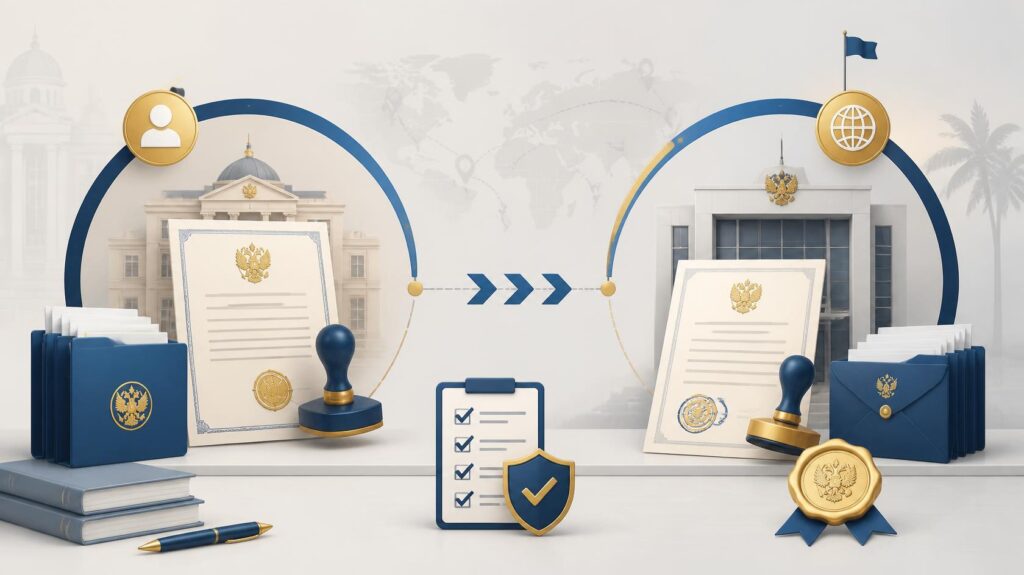
Applicants often ask why they cannot take their degree straight to an embassy for attestation. The answer lies in how the authentication chain is designed: each authority relies on the one beneath it, and for educational certificates, HRD attestation is the foundation the rest of the chain is built on.
Attestation is a chain of trust
Document attestation works like a series of endorsements. A higher authority will only add its stamp once a recognized lower authority has verified the document first. For an educational certificate, that lower authority is the State Human Resource Development (HRD) department, which verifies the qualification directly with the issuing university or board.
Why the embassy needs HRD first
An embassy or consulate does not have the means to verify an Indian university degree at source. What it can do is rely on the Indian government’s verification. So the embassy looks for the Ministry of External Affairs (MEA) stamp — and the MEA, in turn, relies on the State HRD attestation. Remove the HRD step and the entire chain loses its foundation; the MEA and embassy would be attesting a document that was never verified with the university.
The typical order for educational documents
- University genuineness verification (where required).
- State HRD attestation.
- MEA attestation.
- Embassy/consulate attestation (for non-Hague countries) or MEA apostille (for Hague countries).
Where the SDM route fits in
Some applicants use the Sub-Divisional Magistrate (SDM) route instead of HRD for faster processing. An SDM can attest documents at the state level, and the MEA accepts SDM attestation. However, a few destination countries and universities specifically want HRD attestation for degrees and may not accept the SDM alternative. Because HRD verifies with the university while the SDM does not, HRD is the safer choice for educational certificates whenever your destination or employer is strict.
The sequence is not red tape for its own sake — it is what makes your attested degree trustworthy abroad. Start with HRD, let the MEA and embassy build on it, and choose the SDM shortcut only when you are certain your destination will accept it.
Quick FAQ
Can I get embassy attestation without HRD attestation?
Generally no for educational certificates. The embassy relies on MEA attestation, which relies on state (HRD) verification, so HRD normally comes first.
Is SDM attestation a valid alternative to HRD?
The MEA accepts SDM attestation, but some countries and universities insist on HRD for degrees. Use SDM only when your destination accepts it.
Why is HRD attestation often the slowest step?
Because HRD verifies the qualification directly with the issuing university, which takes time and varies by state.
How Manav Corporate Consultants can help
At Manav Corporate Consultants (MCC), we manage the complete attestation and apostille journey end to end — state verification, MEA, embassy legalisation and destination-country formalities — with doorstep document pick-up and drop across India. As an ISO 9001:2015-certified, MEA-licensed firm, we keep the process fast, transparent and hassle-free.
Mumbai – +91 7738980318 / Chennai – +91 96770 59423 / Pune – +91 9970466594 | info@manavconsultants.com | www.manavconsultants.com