
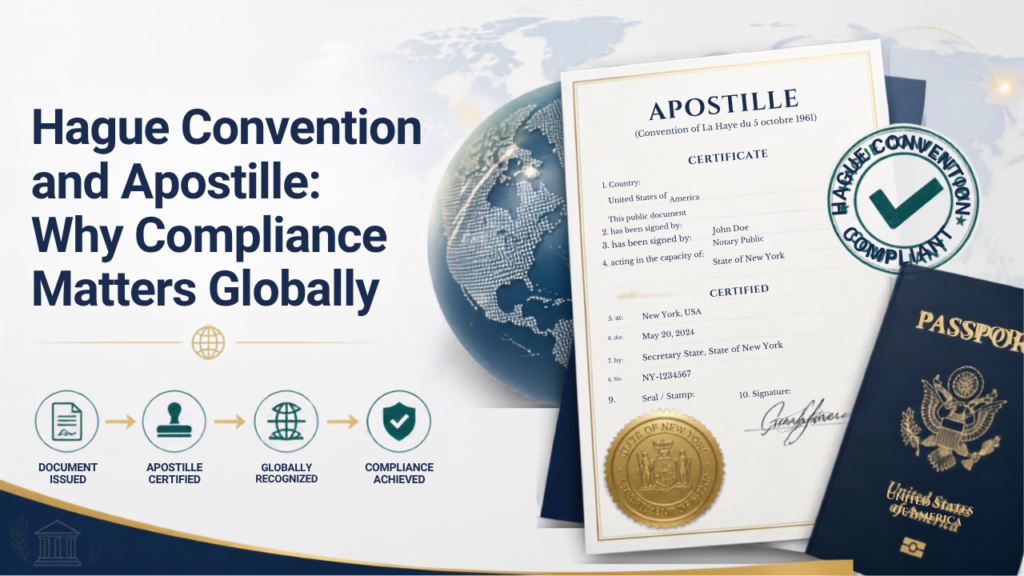
Whether you are relocating, expanding a company overseas or simply travelling for an extended stay, your documents only work abroad if they are authenticated in a way the destination accepts. For Hague Convention countries, that means apostille compliance — and getting it right protects both individuals and businesses from costly setbacks.
What “compliance” really means
Compliance is simply using the correct authentication route for your destination. For a Hague member, that is an apostille issued by the Ministry of External Affairs after proper state-level verification. Submitting a document without it — or with the wrong kind of legalisation — means the receiving authority can reject it outright.
Why it matters for travellers and families
Personal documents such as birth, marriage and death certificates and PCCs frequently need apostilles for residence permits, family visas, school admissions and legal matters abroad. A non-compliant document can stall a visa or a school enrolment at the worst possible moment.
Why it matters even more for business
Companies operating across borders rely on apostilled commercial documents — incorporation papers, powers of attorney, board resolutions, invoices and certificates of origin. A single non-compliant document can hold up a company registration, a tender, a bank account opening or a contract signing in another country. For businesses, compliance is not paperwork; it is deal continuity.
How to stay compliant from India
- Confirm whether your destination is a Hague member — if yes, you need an apostille, not embassy attestation.
- Route each document through the correct state authority first (HRD, Home Department/SDM, or Chamber of Commerce).
- Obtain the MEA apostille and keep the online verification reference.
- Check any destination-specific extras — some member countries still request additional verification for certain document types.
A note on non-members
For non-Hague destinations such as the UAE, Qatar and Kuwait, compliance means the full embassy legalisation chain instead. The principle is the same: match the route to the destination, every time.
Hague compliance is the difference between a document that works on arrival and one that gets handed back. For travellers it protects the move; for businesses it protects the deal. Either way, it is worth getting right the first time.
Quick FAQ
What happens if my document is not apostille-compliant?
The destination authority can reject it, stalling your visa, admission, registration or contract until it is correctly authenticated.
Do businesses need apostilles too?
Yes — commercial documents like incorporation papers, powers of attorney and invoices need apostilles for use in Hague member countries.
How do I know if I need an apostille or embassy attestation?
Check your destination’s Hague status: members require an apostille; non-members (e.g. UAE, Qatar, Kuwait) require embassy attestation.
How Manav Corporate Consultants can help
At Manav Corporate Consultants (MCC), we manage the complete attestation and apostille journey end to end — state verification, MEA, embassy legalisation and destination-country formalities — with doorstep document pick-up and drop across India. As an ISO 9001:2015-certified, MEA-licensed firm, we keep the process fast, transparent and hassle-free.
Mumbai – +91 7738980318 / Chennai – +91 96770 59423 / Pune – +91 9970466594 | info@manavconsultants.com | www.manavconsultants.com