
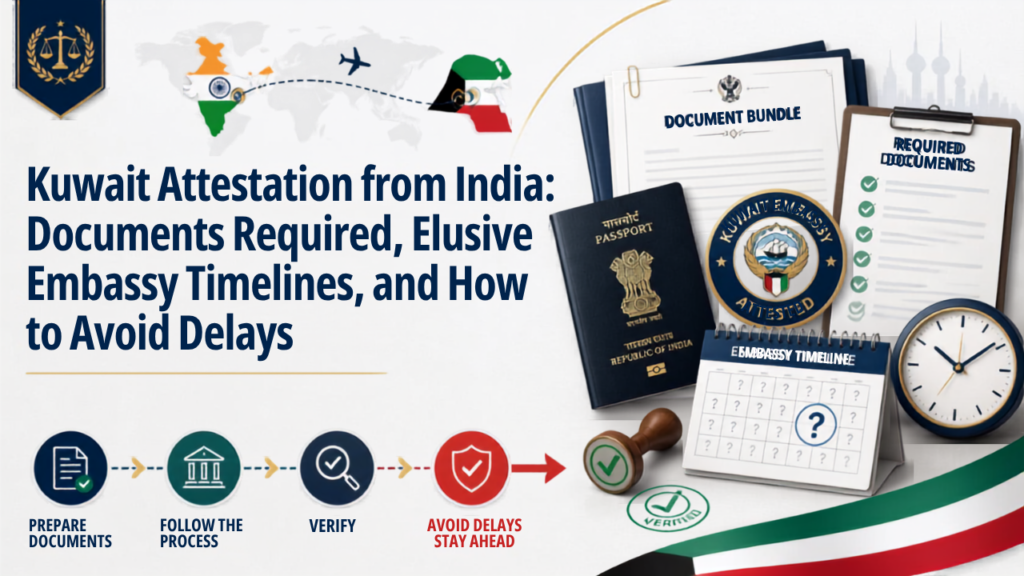
Kuwait attestation is one of those tasks that looks simple on paper and turns complicated in practice. Because Kuwait is not a member of the Hague Apostille Convention, every Indian document bound for Kuwait must go through full embassy legalization — and the Kuwait Embassy’s timelines have a reputation for being hard to predict. Add a single missing stamp or a mismatched name, and a routine attestation can stretch from weeks into months. This guide covers what you need, why the wait is unpredictable, and how to keep your application on track.
Why Kuwait attestation is unavoidable
Kuwait runs an employer-driven, document-first system. Before Kuwaiti authorities can issue a work permit, residence visa, family visa, or business license, your Indian certificates must be legally attested so they can trust they are genuine. Without that attestation, applications are simply not processed — which is why getting it right matters more than getting it done quickly.
Documents required for Kuwait attestation
The documents fall into three familiar categories, and each takes a slightly different verification route:
- Educational documents — degree, diploma, postgraduate and professional certificates, mark sheets and school certificates. Needed for employment, professional registration and study.
- Personal documents — birth, marriage and death certificates, police clearance certificates, affidavits and powers of attorney. Marriage and birth certificates are essential for spouse and dependent (family) visas.
- Commercial documents — incorporation papers, invoices, board resolutions and export documents, for business and trade in Kuwait.
Alongside the document itself, you will usually need clear passport copies and, in many cases, supporting papers such as mark sheets for a degree or the original registrar-issued certificate for personal documents. Missing or unclear supporting documents are one of the most common reasons an application is queried.
The attestation chain, step by step
- State-level verification — HRD for educational documents, the Home Department or an SDM for personal documents, and the Chamber of Commerce for commercial documents.
- MEA attestation — the Ministry of External Affairs, Government of India, authenticates the document for international use.
- Kuwait Embassy attestation — the MEA-attested document is legalized by the Embassy of Kuwait in New Delhi.
- MOFA Kuwait — a final attestation by Kuwait’s Ministry of Foreign Affairs, typically completed in Kuwait, often by the employer.
Why Kuwait Embassy timelines are so elusive
Unlike a fixed government service with a published turnaround, the Kuwait Embassy stage has no reliable, guaranteed timeline. Several moving parts pull it in different directions:
- Embassy workload. Processing time rises and falls with the volume of applications the embassy is handling at any given moment — busy periods can add days or weeks with little warning.
- Document type. Educational documents often take longer than personal ones because of the deeper verification behind them.
- State of issuance. The earlier state-verification stage varies significantly from one Indian state to another, and a slow HRD or Home Department stage delays everything downstream.
- Courier and logistics. Documents physically travel between authorities and the embassy in New Delhi; transit and return-courier times add up, especially from other cities.
Because these factors stack on top of each other, two people submitting similar documents in the same month can experience very different waits. Planning around the worst case, not the best, is the only safe approach.
How small lapses turn into big delays
The single biggest cause of avoidable delay is not the embassy — it is the paperwork. A minor technicality at submission can send a document all the way back to the start:
- Name, date-of-birth or passport-number mismatches between the certificate and your passport.
- Missing signatures, seals or stamps from a prior stage — the embassy will not attest a document that skipped or botched an earlier step.
- Attempting embassy attestation before completing state and MEA attestation.
- Incomplete supporting documents — missing mark sheets, passport copies or photographs.
- Errors on application forms, or the wrong form for the document type.
- Submitting a distance-learning or open-university degree that may not be recognized for attestation.
Each of these looks trivial in isolation, but any one of them can mean a rejected submission, a fresh courier cycle and weeks of lost time — often discovered only after the document has already travelled up the chain.
A 2026-point worth knowing
Kuwait now pays close attention to how qualifications match the job. Under Kuwait’s Public Authority for Manpower (PAM), records are assessed against the qualification on your original permit, and a higher qualification can be rejected at residency renewal unless it is properly authenticated. In practice, this makes accurate, correctly attested degree certificates more important than ever — a shortcut taken now can surface as a problem at renewal later.
How to keep your Kuwait attestation on track
- Start early — build in a buffer of weeks, not days, especially for educational documents.
- Check every detail against your passport before anything is submitted.
- Complete the chain in the correct order and keep every receipt, reference number and stamped copy.
- Confirm whether a distance-learning qualification will be accepted before you begin.
- Work with an experienced partner who tracks the process and catches technicalities before the embassy does.
Kuwait attestation rewards preparation and punishes shortcuts. The embassy timeline may be outside your control, but the paperwork is entirely within it — and getting the documents flawless the first time is the surest way to avoid the delays that catch so many applicants out.
Quick FAQ
How long does Kuwait attestation from India take?
There is no fixed timeline. Depending on the document type, the state of issuance, and the Kuwait Embassy’s workload, it can take from a couple of weeks to over a month — sometimes longer. Plan for the worst case.
Does Kuwait accept an apostille instead of embassy attestation?
No. Kuwait is not a Hague Convention member, so documents need full embassy attestation followed by MOFA Kuwait — an apostille is not accepted.
What is the most common cause of delay?
Document discrepancies — name or date mismatches, missing signatures or stamps, incomplete supporting documents, or attempting embassy attestation before completing the state and MEA stages.
Which documents are needed for a Kuwait family visa?
Attested marriage and birth certificates are typically required to sponsor a spouse or dependents, alongside the main applicant’s attested documents.
How Manav Corporate Consultants can help
At Manav Corporate Consultants (MCC), we manage Kuwait attestation end-to-end — state verification, MEA, and Kuwait Embassy legalization — with careful document checks that catch technicalities before they cause delays. As an ISO 9001:2015-certified, MEA-licensed firm with doorstep pick-up and drop-off across India, we take the guesswork out of an unpredictable process, so your visa and mobilization stay on schedule.
Mumbai – +91 7738980318 / Chennai – +91 96770 59423 / Pune – +91 9970466594 | info@manavconsultants.com | www.manavconsultants.com