
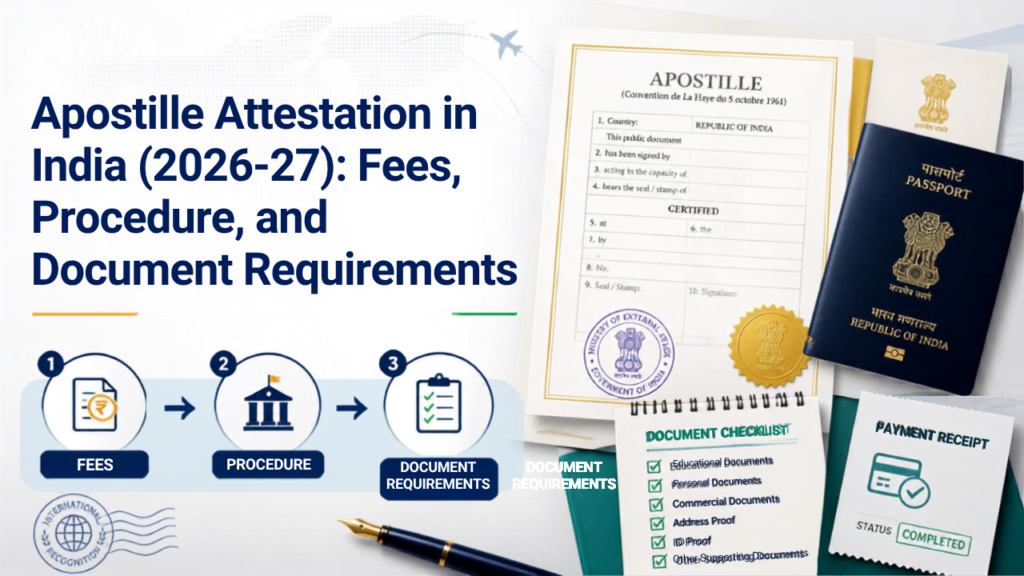
If your documents are bound for a Hague Convention country, an apostille is what makes them valid there. This 2026 guide sets out the procedure, the documents you need to keep ready, and what the process typically costs — so there are no surprises along the way.
The procedure, step by step
- State-level authentication first: HRD for educational documents, Home Department or SDM for personal documents, and the Chamber of Commerce for commercial documents.
- MEA apostille: the Ministry of External Affairs then applies the apostille sticker, either on the physical original or, for eligible digital documents, through the e-Sanad platform.
- Verification: every apostille carries a unique number you can check on the e-Sanad portal.
Note that the MEA does not accept documents directly from the public at a counter for most cases; applications are routed through authorised outsourced agencies or the online system.
Documents you’ll typically need
- The original document to be apostilled.
- A clear photocopy of the document.
- A copy of your passport (and visa or offer letter, where relevant).
- Supporting documents such as mark sheets for degrees, where verification requires them.
Indicative fees
Costs vary by document type, state, urgency and service provider, so treat any figure as indicative and confirm current rates. In broad terms: the MEA’s apostille is a nominal government charge per document (long cited at around ₹50), while state attestation, service-provider handling and courier add to the total. All-in costs commonly range from a few hundred to a few thousand rupees per document, with educational documents and urgent processing at the higher end.
How long it takes
For straightforward personal documents, apostille can be completed in a few working days once state verification is done. Educational documents take longer because HRD verifies with the university. Digital apostille through e-Sanad for eligible documents often runs around 15–20 working days end to end.
A common pitfall to avoid
An apostille is only valid for Hague Convention members. If your destination is the UAE, Qatar or Kuwait, an apostille will not be accepted — you need embassy attestation instead. Always confirm your destination’s status before choosing the apostille route.
Get the sequence right — state verification, then MEA apostille — keep your supporting documents ready, and confirm current fees before you start. Done in order, apostille attestation in India is far more predictable than it first appears.
Quick FAQ
How much does an apostille cost in India in 2026?
It varies. The MEA charges a nominal government fee per document (long cited around ₹50); with state attestation, service handling and courier, all-in costs commonly run from a few hundred to a few thousand rupees. Confirm current rates.
How long does apostille take?
A few working days for simple personal documents after state verification; longer for educational documents. Digital apostille via e-Sanad is often around 15–20 working days.
Can I apply for an apostille directly at the MEA?
For most cases, applications go through authorised outsourced agencies or the online e-Sanad system rather than a public MEA counter.
How Manav Corporate Consultants can help
At Manav Corporate Consultants (MCC), we manage the complete attestation and apostille journey end to end — state verification, MEA, embassy legalisation and destination-country formalities — with doorstep document pick-up and drop across India. As an ISO 9001:2015-certified, MEA-licensed firm, we keep the process fast, transparent and hassle-free.
Mumbai – +91 7738980318 / Chennai – +91 96770 59423 / Pune – +91 9970466594 | info@manavconsultants.com | www.manavconsultants.com