
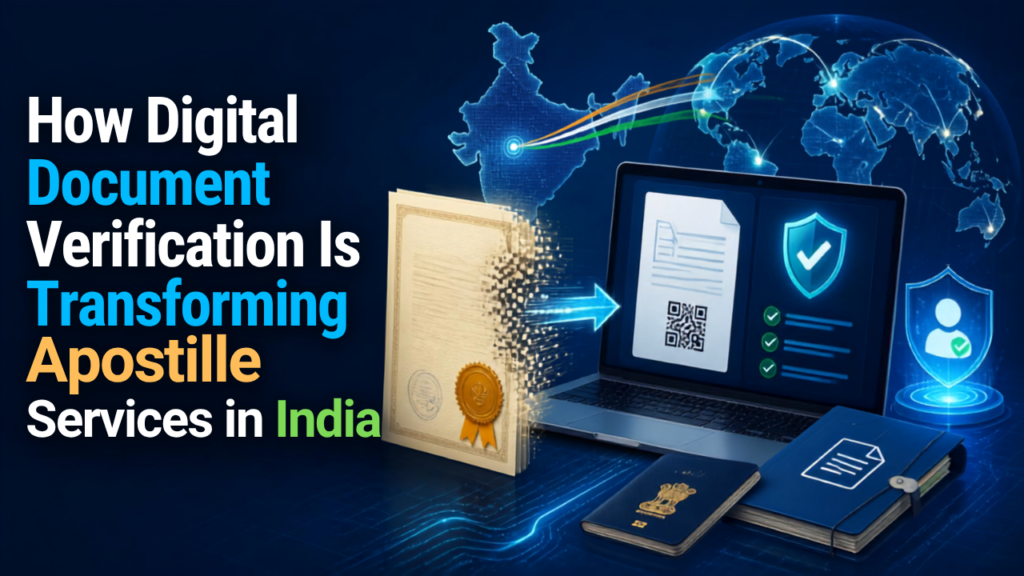
For decades, getting a document apostilled meant couriering physical originals through a chain of offices. That is changing. As India digitizes its records, document verification — the heart of apostille — is increasingly happening electronically, making the process faster and more secure. Here is how the shift is unfolding.
The old bottleneck: verification
The slowest part of any apostille has always been verification at source — confirming with a university, board or authority that a document is genuine. Traditionally this meant physical checks and postal back-and-forth. Digitization targets exactly this bottleneck.
Enter e-Sanad
India’s e-Sanad platform, operated by the Ministry of External Affairs, aims to make verification and apostille contactless, faceless, cashless and paperless. It connects directly with document-issuing authorities to verify credentials electronically, before the MEA applies its apostille — removing much of the physical handling that caused delays.
How it changes things for applicants
- Faster verification when your issuing authority is digitally integrated.
- Less physical courier movement of precious original documents.
- Apostilles with unique numbers that can be verified online, improving security and reducing fraud.
Where the limits still are
The digital route depends on your document already existing in a linked digital depository. Records from many universities and hospitals are not yet integrated, so those documents still follow the traditional physical process. The system is expanding in phases, so coverage keeps growing — but for now, whether you can go digital depends on the issuing authority.
What it doesn’t change
Digitization speeds up verification, but the fundamentals hold: an apostille is still only valid for Hague Convention countries, and non-members such as the UAE, Qatar and Kuwait still require embassy attestation. Digital or physical, the destination decides the route.
Digital document verification is quietly modernizing apostille services in India — faster, safer and less paper-heavy where it applies. As more authorities integrate, the digital route will become the norm rather than the exception.
Quick FAQ
What is e-Sanad?
India’s online platform, operated by the MEA, for contactless verification, attestation and apostille of documents held in linked digital depositories.
Can every document be apostilled digitally?
No — only documents whose issuing authority is integrated with a digital depository. Others still follow the traditional physical process.
Does digital apostille change which countries accept it?
No. An apostille is valid only for Hague members; non-members such as the UAE, Qatar and Kuwait still need embassy attestation.
How Manav Corporate Consultants can help
At Manav Corporate Consultants (MCC), we handle the complete apostille and attestation journey — notarization, state and Chamber of Commerce verification, MEA apostille and embassy legalization — with doorstep pick-up and drop across India and genuine, online-verifiable results. As an ISO 9001:2015-certified, MEA-licensed firm, we keep the process fast, transparent and trustworthy.
Mumbai – +91 7738980318 / Chennai – +91 96770 59423 / Pune – +91 9970466594 | info@manavconsultants.com | www.manavconsultants.com