
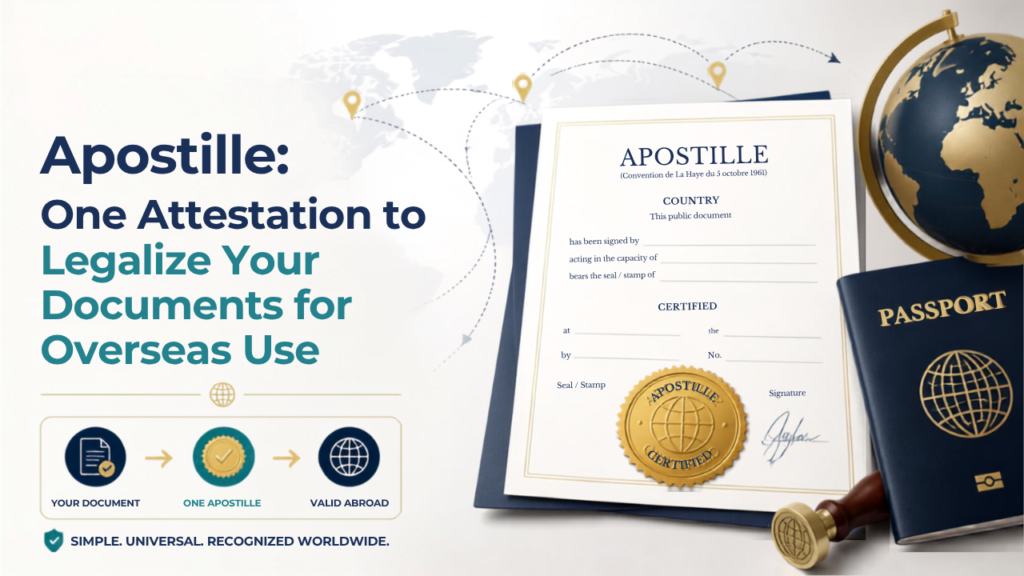
When a foreign university, employer or government asks for an apostille, it can feel like one more hoop to jump through. But there is solid reasoning behind the requirement. Understanding why the apostille exists makes it easier to see it as protection rather than paperwork.
The core problem it solves
A foreign authority has no direct way to know whether an Indian degree, birth certificate or company document is genuine. They cannot call your university or your local registrar to check. The apostille solves this trust gap: it is India’s own government confirming that the signature and seal on your document are authentic, in a format the destination country has agreed to accept.
What the apostille actually certifies
Importantly, an apostille does not certify that the contents of your document are true — it certifies that the signature and seal of the Indian authority which attested it are genuine. In other words, it is a second-layer signature check confirming the verification that already happened at the state level. That is exactly why documents must be authenticated by the HRD, Home Department, SDM or Chamber of Commerce before the MEA can apostille them.
Why countries insist on it
- Fraud prevention: it makes forged or overstated qualifications far harder to pass off.
- Legal recognition: an apostilled document has clear legal standing in the destination country.
- Efficiency: a single recognised certificate replaces a slow chain of embassy legalisations between member states.
When an apostille is the wrong tool
An apostille only legalises documents for Hague Convention member countries. For non-members such as the UAE, Qatar and Kuwait, an apostille has no standing and full embassy attestation is required instead. Using the wrong route is one of the most common and costly mistakes applicants make.
The apostille requirement is not bureaucratic box-ticking — it is how countries extend trust to each other’s documents without re-investigating every one. Seen that way, the apostille is less an obstacle and more a passport that lets your paperwork travel.
Quick FAQ
Why do foreign authorities require an apostille?
Because they cannot independently verify Indian documents. An apostille is India’s government confirming the document’s signatures and seals are genuine, in a format the destination accepts.
Does an apostille prove my document’s contents are true?
No. It certifies the signature and seal of the authority that attested it — not the truth of the contents.
Is an apostille valid everywhere?
Only in Hague Convention member countries. Non-members such as the UAE, Qatar and Kuwait require embassy attestation instead.
How Manav Corporate Consultants can help
At Manav Corporate Consultants (MCC), we manage the complete attestation and apostille journey end to end — state verification, MEA, embassy legalisation and destination-country formalities — with doorstep document pick-up and drop across India. As an ISO 9001:2015-certified, MEA-licensed firm, we keep the process fast, transparent and hassle-free.
Mumbai – +917738980318 / Chennai – +91 96770 59423 / Pune – +91 9970466594 | info@manavconsultants.com | www.manavconsultants.com