
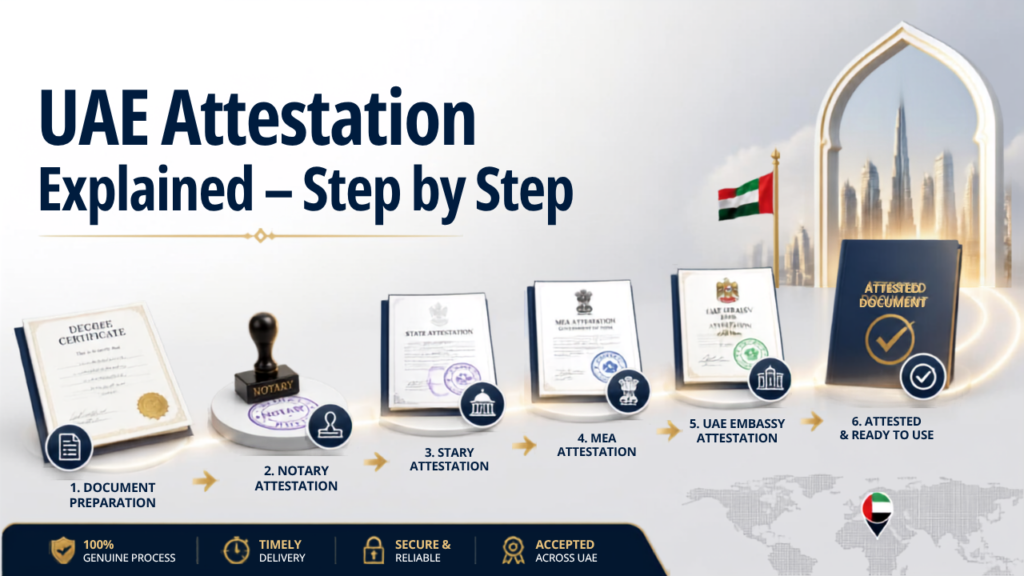
You hand over your original certificate, get a receipt, and then… silence for a few days or weeks. For most applicants, attestation is a black box. Understanding what actually happens to your document behind the scenes makes the wait far less anxious — and helps you spot where delays creep in.
Step 1 — Intake and scrutiny
The moment your document is submitted, it is checked for basic eligibility: is it an original or a properly certified copy, are the names consistent with your passport, and is the issuing authority recognised? Many rejections happen right here, so this quiet first step matters more than people realise.
Step 2 — Verification at source
Depending on the document type, it goes to the authority that can confirm it is genuine: the State HRD for educational certificates (which checks with your university), the State Home Department or a Sub-Divisional Magistrate for personal certificates, or the Chamber of Commerce for commercial ones. This source verification is the real substance of attestation — and usually the slowest part.
Step 3 — MEA attestation or apostille
Once a recognised state authority has vouched for the document, it travels to the Ministry of External Affairs (MEA). For a Hague Convention destination, the MEA applies an apostille — a numbered, computer-generated sticker. For a non-Hague destination, the MEA applies an attestation stamp that the destination embassy will build on.
Step 4 — Embassy legalisation (non-Hague countries only)
If your document is bound for a country such as the UAE, Qatar or Kuwait, it then goes to that country’s embassy or consulate in India, which adds its own legalisation. Hague-country documents skip this step entirely because the apostille is enough.
Step 5 — Destination-country attestation
For many employment cases, a final attestation happens in the destination country — for example, attestation by the destination’s Ministry of Foreign Affairs after arrival, often arranged by the employer. Only then is the document considered fully legalised.
Step 6 — Return and tracking
Finally, your originals are returned to you, ideally with tracking so you know exactly where they are. Reputable service providers offer real-time status updates throughout, so the black box becomes a glass one.
Attestation is not a single stamp but a relay race between authorities, each confirming what the last one established. Knowing the legs of that race helps you prepare the right supporting documents and set realistic expectations for timelines.
Quick FAQ
How long does the whole attestation journey take?
It depends on the document type and destination, but the source-verification stage (HRD, Home Department or Chamber) is usually the longest leg. Educational documents typically take longer than personal ones.
Can I track my document during attestation?
Yes — many service providers offer real-time tracking so you can see which stage your document is at.
Where do most delays happen?
At the initial scrutiny (due to name mismatches or unclear copies) and at source verification, especially HRD verification with universities.
How Manav Corporate Consultants can help
At Manav Corporate Consultants (MCC), we manage the complete attestation and apostille journey end to end — state verification, MEA, embassy legalisation and destination-country formalities — with doorstep document pick-up and drop across India. As an ISO 9001:2015-certified, MEA-licensed firm, we keep the process fast, transparent and hassle-free.
Mumbai – +91 7738980318 / Chennai – +91 96770 59423 / Pune – +91 9970466594 | info@manavconsultants.com | www.manavconsultants.com