
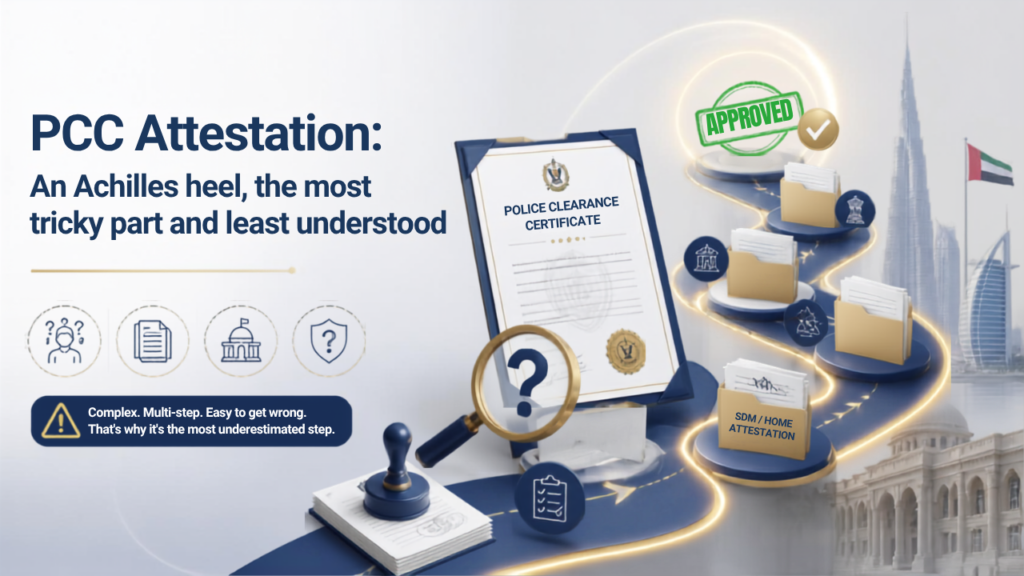
A Police Clearance Certificate (PCC) is often one of the last documents a visa applicant sorts out — and one of the most likely to derail a timeline. Because a PCC can be issued by different authorities and has a limited shelf life, its attestation is uniquely prone to delays. Here are the usual culprits and how to stay ahead of them.
- The PCC was issued by the wrong authority
A PCC can come from local police, a Regional Passport Office, or in some cases be issued abroad. The issuing authority affects how it must be verified and attested. A PCC issued by a passport office is treated differently from one issued by local police, and using the wrong one for your destination can mean starting over.
- Name or passport mismatches
If the name, passport number or address on your PCC does not exactly match your passport, expect a query or rejection. This is the single most common avoidable delay — check every field before submission.
- The PCC expired mid-process
Many countries accept a PCC only if it is recent — often within three to six months. If your PCC sits unused while you gather other documents, it can age out before attestation is complete, forcing a fresh application. Sequence your PCC late enough that it stays valid through submission.
- Missing state-level verification
Like other personal documents, a PCC usually needs state Home Department or Sub-Divisional Magistrate verification before MEA attestation. Skipping straight to the MEA or embassy leads to the document being sent back.
- Destination-specific rules
Requirements differ by country. Hague members such as Oman and Bahrain accept an MEA apostille on the PCC, while non-Hague countries such as the UAE, Qatar and Kuwait need embassy attestation on top. Applying the wrong route wastes days.
How to avoid PCC delays
- Confirm which issuing authority your destination requires before you apply for the PCC.
- Double-check that every detail matches your passport exactly.
- Time your PCC so it remains valid through the entire attestation process.
- Complete state verification before approaching the MEA or embassy.
- Confirm whether your destination needs an apostille or embassy attestation.
A PCC delay is almost always preventable. Get the issuing authority, the details, the timing and the route right from the start, and this last-minute document won’t become the reason your visa slips.
Quick FAQ
How long is a PCC valid for attestation?
Many countries accept a PCC issued within the last three to six months. Check your destination’s rule and time your application so it does not expire mid-process.
Does a PCC need state verification before MEA attestation?
Yes, a PCC is a personal document and usually needs Home Department or SDM verification before the MEA attests or apostilles it.
Apostille or embassy attestation for a PCC?
Hague-member destinations (e.g. Oman, Bahrain) take an MEA apostille; non-Hague destinations (e.g. UAE, Qatar, Kuwait) need embassy attestation as well.
How Manav Corporate Consultants can help
At Manav Corporate Consultants (MCC), we manage the complete attestation and apostille journey end to end — state verification, MEA, embassy legalisation and destination-country formalities — with doorstep document pick-up and drop across India. As an ISO 9001:2015-certified, MEA-licensed firm, we keep the process fast, transparent and hassle-free.
Mumbai – +91 7738980318 / Chennai – +91 96770 59423 / Pune – +91 9970466594 | info@manavconsultants.com | www.manavconsultants.com