
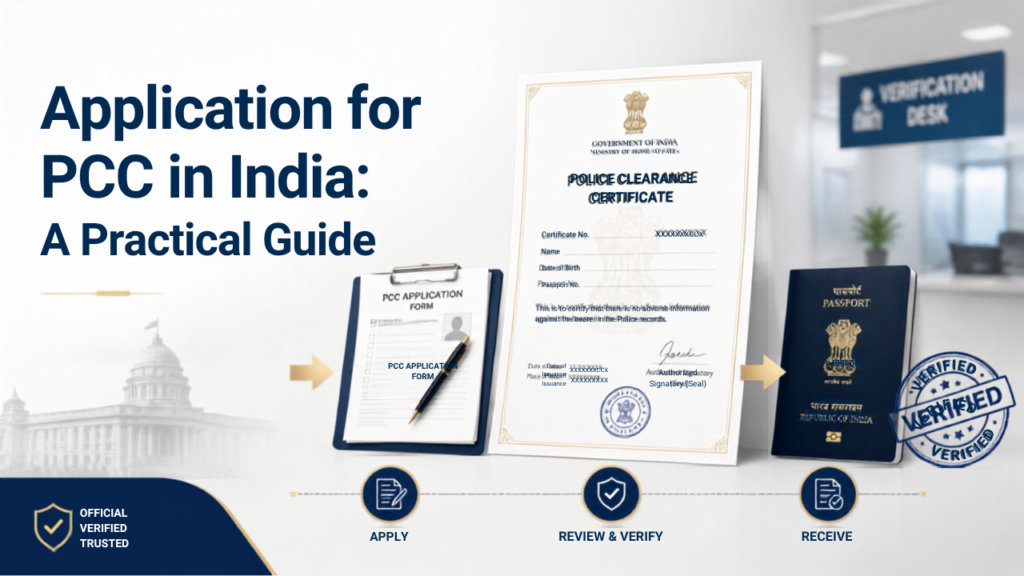
A Police Clearance Certificate confirms you have no criminal record, and most countries require it — duly attested — for work visas, residence permits and immigration. This guide walks through how to get your PCC attested in India, cleanly and in the right order.
Step 1 — Obtain the correct PCC
First, get your PCC from the right authority. For most overseas employment and residence purposes, the Regional Passport Office (via the Passport Seva portal) or your local police issues it. Which one you need depends on your destination country’s requirement, so confirm this before applying.
Step 2 — State-level verification
As a personal document, your PCC is verified at the state level — by the State Home Department or, for faster processing, a Sub-Divisional Magistrate (SDM). This step confirms the certificate’s authenticity before it can move up the chain.
Step 3 — MEA attestation or apostille
The Ministry of External Affairs (MEA) then attests the PCC. If your destination is a Hague Convention country — such as Oman, Bahrain or Saudi Arabia — the MEA applies an apostille, and no embassy step is needed. If it is a non-Hague country, the MEA applies an attestation stamp in preparation for embassy legalisation.
Step 4 — Embassy attestation (for non-Hague countries)
For destinations such as the UAE, Qatar and Kuwait, the MEA-attested PCC is then legalised by that country’s embassy or consulate in India.
Step 5 — Destination MOFA (where required)
Some countries require a final attestation by their own Ministry of Foreign Affairs after you arrive, frequently arranged through the employer. Confirm whether this applies to you.
Documents you’ll usually need
- Original PCC (recent — typically within three to six months).
- Clear copy of your passport (and visa/offer letter where relevant).
- Any supporting identification the verifying authority requests.
The key to a smooth PCC attestation is sequence and timing: get the right PCC, verify it at the state level, then let the MEA and, where needed, the embassy build on it — all while the certificate is still within its validity window.
Quick FAQ
Who issues a PCC in India?
Usually the Regional Passport Office (through Passport Seva) or your local police, depending on your destination country’s requirement.
Do I need an apostille or embassy attestation on my PCC?
Hague-member countries accept an MEA apostille; non-Hague countries such as the UAE, Qatar and Kuwait also require embassy attestation.
How recent must my PCC be?
Most countries want a PCC issued within the last three to six months, so time your application accordingly.
How Manav Corporate Consultants can help
At Manav Corporate Consultants (MCC), we manage the complete attestation and apostille journey end to end — state verification, MEA, embassy legalisation and destination-country formalities — with doorstep document pick-up and drop across India. As an ISO 9001:2015-certified, MEA-licensed firm, we keep the process fast, transparent and hassle-free.
Mumbai – +917738980318 / Chennai – +91 96770 59423 / Pune – +91 9970466594 | info@manavconsultants.com | www.manavconsultants.com