
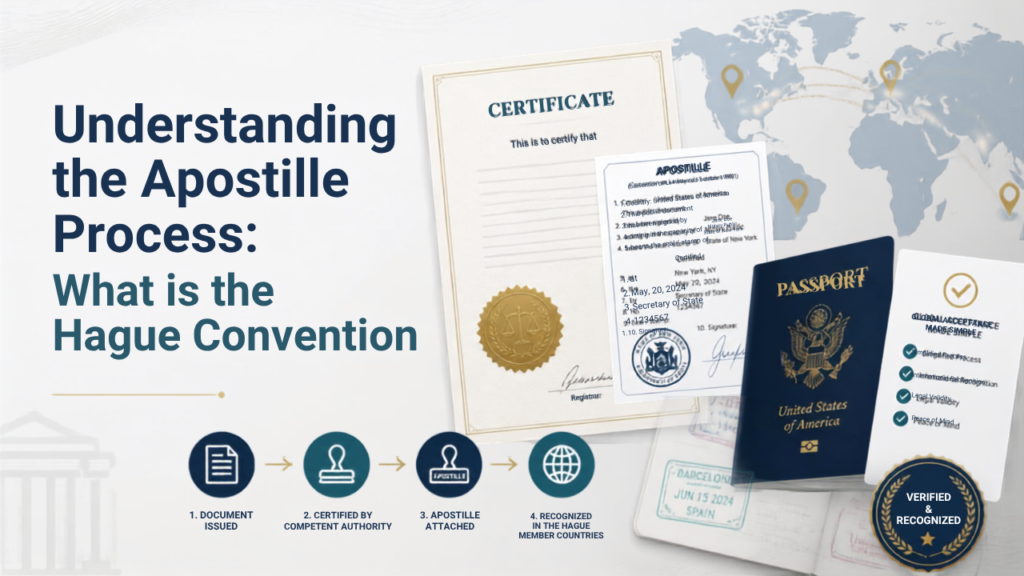
If your documents are headed to a country that belongs to the Hague Convention, you will hear the word “apostille” a lot. It sounds technical, but the idea behind it is refreshingly simple: one stamp that lets a document cross borders without a pile of extra legalisation. Here is how it works and why it exists.
What the Hague Convention set out to fix
Before the Convention, using a document abroad meant a long chain of legalisations — your government, then the destination’s embassy, sometimes more. The Hague Convention of 1961 replaced that chain, between member countries, with a single certificate called an apostille. India joined in 2005, and today well over 120 countries are members. So for all 120 plus member countries, attestation of the respective Ministry of External Affairs is enough for the document to be used in any of the other member countries.
What an apostille actually is
An apostille is a standardized certificate — in India, a numbered, computer-generated sticker — issued by a designated competent authority confirming that a public document is genuine. Once a document carries it, every other member country must accept it without demanding further embassy legalization.
Who issues apostilles in India
In India, the Ministry of External Affairs (MEA) is the sole competent authority for apostilles. But the MEA does not verify documents at source; it apostilles documents that have already been authenticated at the state level — HRD for educational documents, the Home Department or SDM for personal documents, and the Chamber of Commerce for commercial ones.
The apostille process, step by step
- State-level authentication of your document (HRD, Home Department/SDM, or Chamber of Commerce).
- Submission to the MEA (directly or through an authorised outsourced agency).
- MEA applies the apostille sticker, which can be verified online.
When an apostille is not enough
An apostille only works between Hague members. If your destination is not a member — the UAE, Qatar and Kuwait are common examples — you cannot use an apostille and must go through full embassy legalisation instead. Always confirm your destination’s Hague status before choosing your route.
The apostille turns what used to be a bureaucratic marathon into a single, internationally trusted stamp. Understand which side of the Hague line your destination sits on, and you will always pick the right process the first time.
Quick FAQ
What is an apostille in simple terms?
A single certificate that confirms your public document is genuine and makes it acceptable in any other Hague Convention country without further embassy legalisation.
Who issues apostilles in India?
The Ministry of External Affairs (MEA) is the sole competent authority, acting on documents already verified at the state level.
Can I use an apostille for the UAE?
No. The UAE is not a Hague member, so it requires full embassy attestation instead of an apostille.
How Manav Corporate Consultants can help
At Manav Corporate Consultants (MCC), we manage the complete attestation and apostille journey end to end — state verification, MEA, embassy legalisation and destination-country formalities — with doorstep document pick-up and drop across India. As an ISO 9001:2015-certified, MEA-licensed firm, we keep the process fast, transparent and hassle-free.
Mumbai – +91 7738980318 / Chennai – +91 96770 59423 / Pune – +91 9970466594 | info@manavconsultants.com | www.manavconsultants.com