
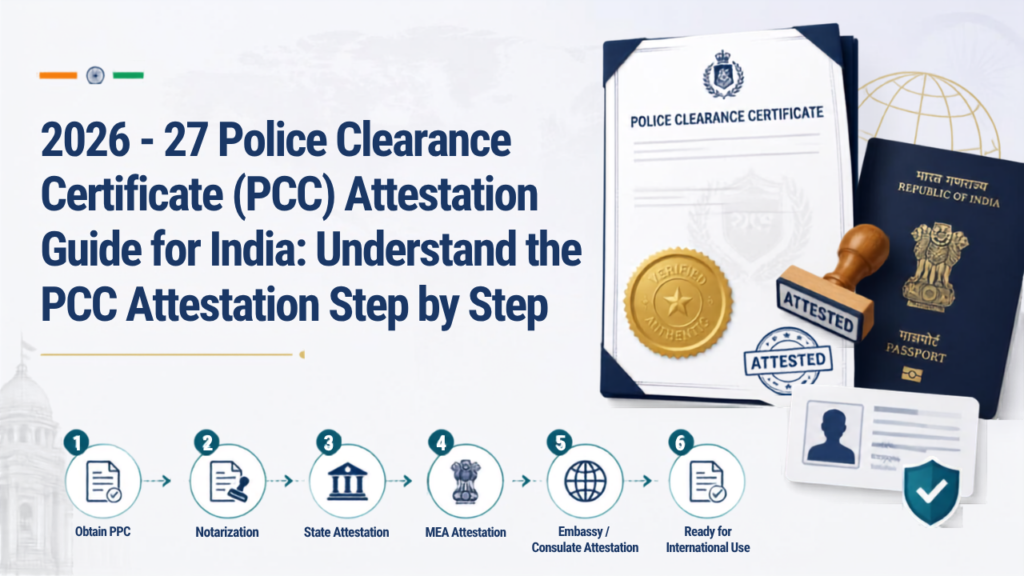
A Police Clearance Certificate (PCC) is a standard requirement for work visas, residence permits and immigration — and it must be properly attested to be accepted abroad. This 2026 reference brings together everything you need: who issues a PCC, how attestation works, which route your destination needs, and the mistakes that cause delays.
Who issues a PCC in India
Depending on your destination and purpose, a PCC is issued by the Regional Passport Office (through the Passport Seva portal) or by your local police. Some countries specify which one they will accept, so confirm the requirement before applying to avoid getting the wrong version.
The attestation process
- State-level verification: as a personal document, the PCC is verified by the State Home Department or a Sub-Divisional Magistrate (SDM).
- MEA stage: the Ministry of External Affairs then apostilles the PCC (for Hague countries) or attests it (for non-Hague countries).
- Embassy attestation: for non-Hague destinations, the relevant embassy or consulate legalises the MEA-attested PCC.
- Destination MOFA: some countries require a final attestation after arrival, often arranged by the employer.
Which route does your destination need? (2026)
This is where many applicants go wrong, so it is worth being precise:
- Apostille route (Hague members): Oman, Bahrain and Saudi Arabia accept an MEA apostille on the PCC — no embassy step needed.
- Embassy route (non-members): the UAE, Qatar and Kuwait require embassy attestation in addition to MEA attestation.
Validity — mind the clock
Most countries accept a PCC only if it is recent, commonly within three to six months. Because attestation itself takes time, apply for your PCC late enough that it stays valid through the whole process, but early enough to avoid a last-minute scramble. A PCC that expires mid-process means starting again.
Common mistakes that cause delays
- Getting the PCC from the wrong issuing authority for your destination.
- Name, passport-number or address mismatches against your passport.
- Choosing the wrong route — apostille where embassy attestation is needed, or vice versa.
- Letting the PCC expire before attestation is complete.
Documents to keep ready
- Original, recent PCC.
- Clear passport copy (and visa or offer letter where relevant).
- Any identification the verifying authority requests.
PCC attestation is straightforward when you respect two things: the correct route for your destination and the certificate’s validity window. Get the issuing authority and details right, verify at the state level, then apostille or attest as your country requires — and this last-minute document won’t hold up your move.
Quick FAQ
Does a PCC need an apostille or embassy attestation?
It depends on the destination. Hague members (Oman, Bahrain, Saudi Arabia) accept an MEA apostille; non-members (UAE, Qatar, Kuwait) require embassy attestation as well.
How long is a PCC valid for attestation?
Commonly three to six months. Time your application so the PCC stays valid throughout the attestation process.
Who verifies a PCC before MEA attestation?
The State Home Department or a Sub-Divisional Magistrate (SDM), as it is a personal document.
How Manav Corporate Consultants can help
At Manav Corporate Consultants (MCC), we manage the complete attestation and apostille journey end to end — state verification, MEA, embassy legalisation and destination-country formalities — with doorstep document pick-up and drop across India. As an ISO 9001:2015-certified, MEA-licensed firm, we keep the process fast, transparent and hassle-free.
Mumbai – +91 7738980318 / Chennai – +91 96770 59423 / Pune – +91 9970466594 | info@manavconsultants.com | www.manavconsultants.com