
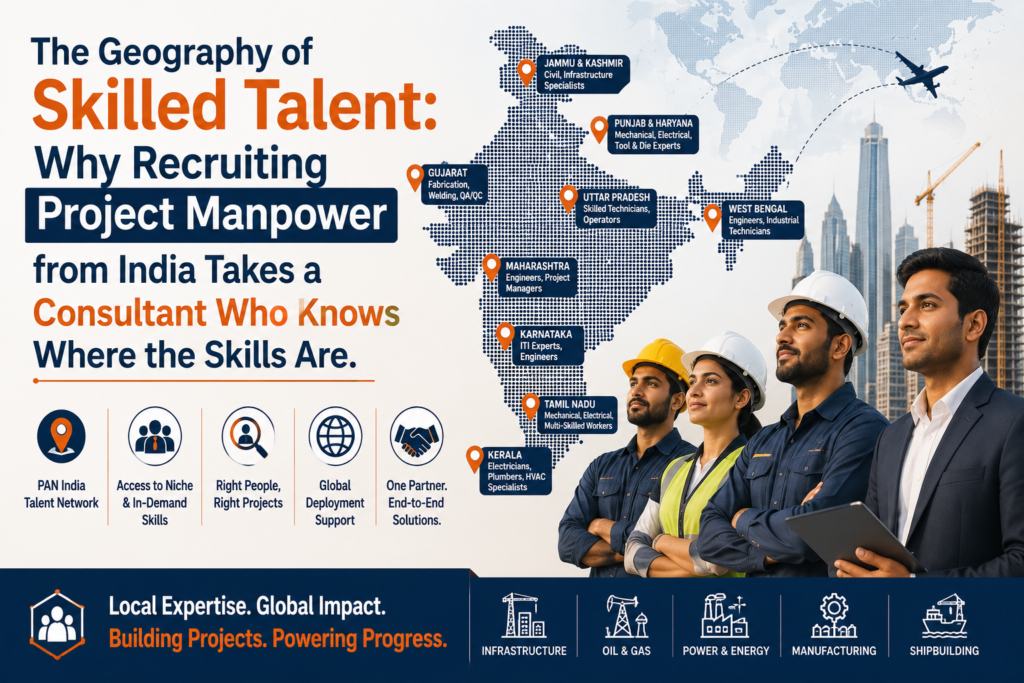
Recruiting a complete project workforce from India — mechanical, civil and electrical trades, all mobilized together — looks straightforward on paper. In practice, it is one of the most complex and risky manpower exercises an overseas company can undertake. The reason is simple but often underestimated: India is not a single labour market. The trades you need are rarely all available in one city, the best sources for each skill are scattered across a country the size of a continent, and planning a recruitment drive across them demands expertise most employers do not have in-house. This is where an experienced recruitment consultant earns its value.
India is not one labour market — it is many
The first thing to grasp is scale. India’s recruitment map runs from Amritsar in the north to Trichy in the south, and from Kolkata in the east to Baroda in the west — distances comparable to crossing a continent. Two interview locations in the same recruitment drive can be thousands of kilometers and several flights apart. An employer who assumes they can fly into one city, interview everyone, and mobilize a full multi-trade workforce is in for an expensive surprise: the welders may be in one region, the masons in another, and the electrical technicians somewhere else entirely.
Skills cluster by region — the map of Indian trades
Over generations, specific trades have concentrated in specific parts of India, shaped by local industry, craft traditions and training ecosystems. Knowing this map is the difference between a productive recruitment drive and a wasted one. In our experience, skilled talent tends to cluster like this:
- Masons and stone workers — strongly represented in Rajasthan, with its deep tradition of stone, marble and construction craft.
- Carpenters — a notable pool in West Bengal, alongside other skilled woodworking talent.
- Welders and fabricators — found in distinct industrial hubs such as Pune, Surat and Visakhapatnam (Vizag), where engineering, fabrication, shipbuilding and heavy industry have built dense concentrations of skilled tradespeople.
- Electrical and instrumentation technicians — well represented across the southern states, with their strong technical-training base.
- General construction and infrastructure labour — drawn in large numbers from the northern and eastern states.
- Refinery, piping and heavy-fabrication trades — clustered around India’s industrial and petrochemical belts.
These are tendencies, not absolutes — skilled people move, and good candidates exist everywhere. But the clustering is real and significant enough that it should shape any serious recruitment plan. An employer who does not know the map cannot design an efficient drive; a consultant who does can go straight to where the right skills actually are.
Why this makes project recruitment complex — and risky
When a project needs, say, 200 welders, 100 masons, 80 carpenters and 60 electrical technicians mobilized on a tight schedule, the geographic reality creates real risk:
- The trades are not co-located, so a single-city drive cannot fill all the positions.
- Chasing candidates across far-flung cities without a plan wastes time, money and interview-panel effort.
- Rushing to whoever is nearby — rather than sourcing from the right pool — risks skill mismatches that surface only after mobilization, when they are most expensive to fix.
- Trade tests, medicals, interview panels and logistics must be coordinated across multiple locations simultaneously.
Get the geography wrong, and a recruitment drive can overrun on cost and time while still failing to deliver the full workforce. Get it right, and the same drive is fast, focused and complete.
Designing the recruitment-drive itinerary
This is the heart of the expertise. Planning a multi-trade, multi-city recruitment drive is a logistical exercise that a good consultant maps out before a single interview is booked:
- Map positions to source regions. Match each trade in the requirement to the region(s) where that skill is genuinely concentrated.
- Cluster the drive intelligently. Group trades and locations to minimize travel and time — deciding which cities to visit, in what order, and which trades to test at each.
- Set up trade-test centers. Arrange practical trade testing at the right locations, to the employer’s standards, so skills are verified before mobilization.
- Coordinate interview panels. Schedule the employer’s panel — in person or by video — across locations, and manage candidate flow so the panel’s time is used efficiently.
- Sequence logistics. Align sourcing, testing, interviews, medicals, documentation and visas across every location so the workforce comes together on one coordinated timeline.
Done well, this itinerary turns a daunting, continent-spanning exercise into a tight, well-run campaign. It is precisely the kind of planning that an employer cannot easily do from abroad — and that an experienced Indian consultant does as a matter of routine.
Why an expert consultant is essential
A capable project-manpower consultant brings three things together that an overseas employer, or an inexperienced agent, simply cannot:
- Understanding of the positions — knowing exactly what a mechanical, civil or electrical role really requires on a project.
- Knowledge of the sourcing map — knowing which skills are concentrated where, so sourcing is targeted rather than scattergun.
- Logistical execution — the ability to plan and run a multi-city drive with trade tests, panels, medicals, and mobilization all coordinated.
Take away any one of these and the drive suffers. Together, they are what make a complex recruitment feel effortless to the employer.
How MCC executes complex, multi-location drives
Manav Corporate Consultants (MCC) has planned and delivered exactly these kinds of complex, multi-trade mobilizations — and the track record shows it:
- 700+ skilled masons, carpenters and steel fitters mobilized for the Meydan City project in Dubai — a large, multi-trade workforce sourced and mobilized together.
- 350+ civil masons and electrical technicians for a high-rise construction site (Abu Dhabi Plaza Tower) in Astana, Kazakhstan — combining civil and electrical trades on one drive.
- 300 technicians selected and mobilized for shutdown requirements with leading operators in Kuwait, against tight timelines.
- 200 welders and fabricators for a manufacturing workshop in Jubail, Saudi Arabia, producing pressure vessels, heat exchangers, piping and skids.
- 300+ welders, fabricators and erectors for structural steel fabrication workshops and sites in the UAE.
- A complete 350-person project team — project manager, project engineers, HSE, welders, fabricators, scaffolders, painters, blasters and camp boss — for a floating-roof crude oil storage tank project in Basra, Iraq.
Each of these required sourcing the right trades from the right parts of India, running trade tests and interviews across locations, and mobilizing a coordinated workforce on schedule. That is not luck — it is the product of knowing the map, understanding the positions, and executing the logistics.
A valuable resource for your next project
If your company is planning a project that needs a multi-trade Indian workforce — mechanical, civil, electrical, and beyond — MCC is built to make it work. Founded by Engineers and HR professionals, with dedicated teams for skilled and technical recruitment, we bring the sourcing-map knowledge, trade-testing capability, and drive-planning expertise that turn a complex, risky exercise into a smooth, complete mobilization. As an ISO 9001:2015-certified, MEA-licensed firm, we handle everything from itinerary design and trade testing to documentation, visas and deployment — through a single, accountable point of contact.
India has the skilled workers and technicians your project needs — but they are spread across a vast, varied country, and finding the right ones takes more than posting a vacancy. It takes a consultant who knows where the skills are and how to bring them together. That is exactly what MCC does.
Quick FAQ
Why can’t I recruit all trades from one city in India?
Because trades cluster by region — masons, carpenters, welders, fabricators, and technicians tend to concentrate in different parts of the country. A full multi-trade workforce usually needs sourcing from several locations.
How far apart can interview locations be?
Very far — India spans from Amritsar in the north to Trichy in the south and Kolkata in the east to Baroda in the west, so two locations can be thousands of kilometers apart. Planning the drive itinerary is essential.
What does an expert consultant add?
Understanding of the positions, knowledge of where each skill is concentrated, and the logistics to run a multi-city drive with trade tests, panels, medicals, and mobilization coordinated.
Has MCC done this before?
Yes — including 700+ masons, carpenters and fitters for Meydan, 350+ civil and electrical trades in Kazakhstan, 300 shutdown technicians in Kuwait, hundreds of welders and fabricators for Saudi and UAE workshops, and complete project teams for oil and gas projects.
Planning a multi-trade project workforce from India? Talk to MCC
Manav Corporate Consultants plans and delivers complex, multi-location recruitment drives for overseas projects — sourcing skilled workers and technicians from the right parts of India, verifying them through trade tests, and mobilizing a coordinated workforce on schedule. Tell us your positions and numbers, and we will design the drive that gets them built.
Mumbai – +91 7738980318 / Chennai – +91 96770 59423 / Pune – +91 9970466594 | info@manavconsultants.com | www.manavconsultants.com