
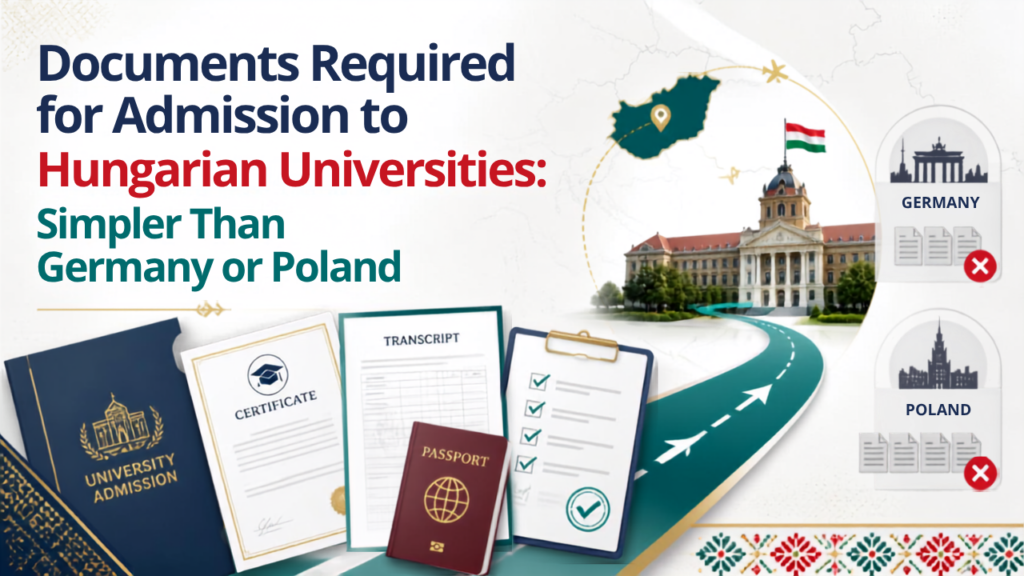
Hungary has quietly become one of the smartest study-abroad choices for Indian students — an affordable, EU-recognized degree, a huge range of English-taught programmes, and a document process that is refreshingly straightforward. If you have looked at Germany’s APS certificate or Poland’s sworn-translation rules and felt overwhelmed, Hungary will come as a relief. Here is what you need, why it is simpler, and how Manav Corporate Consultants (MCC) can handle the paperwork for you.
Why Hungary is a great destination for Indian students
- Affordable, EU-recognized degrees. Tuition and living costs are far lower than Western Europe — Budapest runs roughly EUR 600–900 a month, and cities like Debrecen and Szeged are cheaper still — for a degree recognized across the EU and globally.
- English-taught programmes. Hungarian universities offer hundreds of programmes in English, so you do not need to learn Hungarian to study there.
- World-class medical universities. Semmelweis, Debrecen, Szeged and Pécs have trained international doctors for decades and are a long-standing favourite for Indian medical aspirants.
- The Stipendium Hungaricum scholarship. One of Europe’s most generous fully funded government scholarships — covering tuition, dormitory or housing allowance and a monthly stipend — with a dedicated India quota of around 200+ awards a year across 30+ universities.
- Schengen access and quick visas. Study in the heart of Europe with Schengen travel, and one of the faster EU student-visa processes, with VFS centres across major Indian cities.
Why Hungary’s document process is simpler than Germany or Poland
This is where Hungary really stands out. Compared with two other popular destinations:
- Versus Germany: Germany requires most Indian students to obtain an APS certificate (which can take four to eight weeks) and does not even accept an Indian apostille for visa purposes. Hungary has no APS-style pre-verification — a straightforward apostille does the job.
- Versus Poland: Poland demands a sworn translation into Polish by a translator registered with its Ministry of Justice, and rejects ordinary translations outright. Hungary accepts documents in English — and since most Indian academic documents are already issued in English, many applicants need little or no translation at all.
In short, Hungary keeps the essential apostille step but removes the two biggest headaches — special academic pre-verification and mandatory foreign-language sworn translation — that slow down Germany and Poland applications.
Documents required for admission to a Hungarian university
Requirements vary by university and programme, but the typical set for Indian applicants is:
- Academic certificates — your Class 12 school-leaving certificate for a bachelor’s programme, or your bachelor’s degree for a master’s programme.
- Transcript of records — mark sheets listing subjects and grades.
- Apostille — an MEA apostille on your diploma and transcripts.
- Translation (only if needed) — an official English (or Hungarian) translation, required only where a document is not already in English.
- Proof of English proficiency — IELTS or TOEFL for English-taught programmes.
- Passport and photographs, a motivation letter and CV, and the application/registration fee.
- For medicine: proof of biology and chemistry study, and an entrance exam (Semmelweis, Pécs and Debrecen hold biology/chemistry entrance tests, often in April–May).
- For the student visa: proof of sufficient funds for living costs, alongside your letter of acceptance.
The apostille and translation step — kept simple
Even though Hungary is easier, the apostille is not optional. As India and Hungary are both Hague Convention members, your educational documents must carry an MEA apostille to be accepted. The good news on translation: because your Indian degree and mark sheets are typically issued in English, you often will not need a separate translation at all — and where one is required, English or Hungarian is accepted, with no obligation to use a special sworn translator as Poland demands. Always confirm your specific university’s translation preference before you submit.
Applying through Stipendium Hungaricum?
If you are aiming for the Stipendium Hungaricum scholarship, the same documents apply — with strict deadlines. The single most common reason Indian applications fail the technical check is mark sheets that were not apostilled (or translated, where needed) in time. Begin your apostille the day you start your application, not the week before the deadline.
Timing and common mistakes
- Leaving the apostille too late — state HRD attestation and MEA apostille together take a few weeks; start early.
- Submitting downloaded or photocopied mark sheets that cannot be apostilled — use originals or certified copies.
- Assuming no apostille is needed because Hungary is “easy” — the apostille is still mandatory.
- Name or date mismatches across your passport, certificates and application.
How Manav Corporate Consultants helps you study in Hungary
Hungary makes the process simpler, and MCC makes it effortless. We handle the India-side legalization end to end — state HRD attestation and MEA apostille on your certificates and transcripts — with doorstep pick-up and drop across India and careful checks to catch mismatches before they cause rejections. Where a translation is genuinely required, we guide you on exactly what your university needs, and we help you get your documents ready in time for tight scholarship and intake deadlines. As an ISO 9001:2015-certified, MEA-licensed firm, we turn the one truly essential step — your apostille — into a quick, worry-free formality, whether you are applying self-funded or through Stipendium Hungaricum.
Hungary offers a rare combination: a respected EU degree, real affordability, generous scholarships and a document process that will not tie you in knots. Get your apostille sorted early — or let MCC handle it — and your Hungarian university admission is well within reach.
Quick FAQ
Do Indian documents need an apostille for Hungary?
Yes. Hungary and India are both Hague Convention members, so your educational documents need an MEA apostille to be accepted.
Do I need a Hungarian translation of my documents?
Usually not, if your documents are already in English — which most Indian academic documents are. Translation is required only where a document is not in English or Hungarian, and there is no special sworn-translator rule like Poland’s.
Is Hungary really simpler than Germany or Poland?
For paperwork, yes. Hungary needs no APS certificate (unlike Germany) and no mandatory sworn foreign-language translation (unlike Poland) — just a standard apostille and, where needed, an English translation.
How can MCC help?
MCC handles state HRD attestation and MEA apostille end-to-end, with doorstep pick-up and drop PAN India, document checks, and guidance on any translation and on scholarship/intake deadlines.
Heading to Hungary? Let MCC handle your document apostille
Manav Corporate Consultants (MCC) makes the Hungary document process effortless for Indian students — state HRD attestation and MEA apostille handled end-to-end, doorstep pick-up and drop PAN India, and clear guidance on translations and deadlines for both self-funded and Stipendium Hungaricum applications. Get your certificates admission-ready, on time.
Mumbai – +91 7738980318 / Chennai – +91 96770 59423 / Pune – +91 9970466594 | info@manavconsultants.com | www.manavconsultants.com