
Poland has become one of Europe’s most popular study destinations for Indian students — affordable tuition, respected EU degrees and a growing choice of English-taught programmes. But Polish universities are strict about paperwork, and two requirements catch Indian applicants out more than any other: the apostille on your educational documents, and a sworn translation into Polish. Get either wrong and your application can be rejected before it is even assessed. Here is exactly what you need and how to prepare it.
Do you need an apostille for Poland?
Yes. Poland is a member of the Hague Apostille Convention, and India is a member too — so your Indian educational documents must carry an MEA apostille to be recognized by Polish universities and for your student visa. Because India is outside the EU, OECD and EFTA, this recognition step is genuinely required (students from those regions, and holders of IB/EB diplomas, are often exempt — Indian applicants are not).
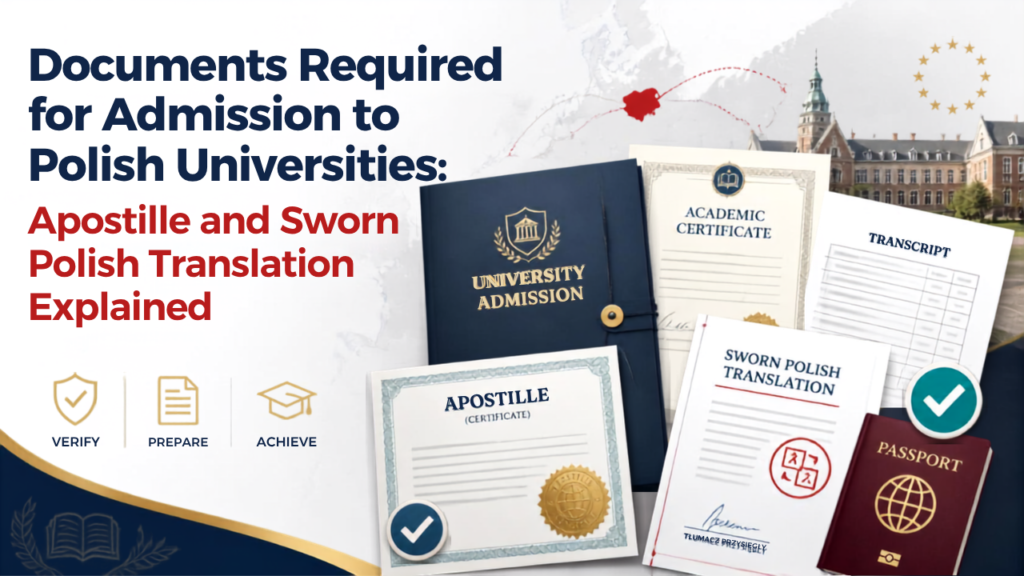
Documents required for admission to a Polish university
While each university sets its own list, almost every Polish institution asks Indian applicants for:
- Academic certificates — your Class 12 (secondary school) certificate for a bachelor’s programme, or your bachelor’s degree for a master’s programme.
- Transcript of records — mark sheets listing subjects and grades.
- Apostille on the above — the MEA apostille that legalizes your documents for Poland.
- Sworn translation into Polish (or English) — a certified translation by a sworn translator (covered in detail below).
- Statement of eligibility — confirmation that your qualification entitles you to higher education; this also needs apostille and translation.
- Passport — valid for at least 18 months, plus passport-size photographs (35×45 mm).
- Language certificate — IELTS, TOEFL or an internal university test for English-taught programmes.
- Application form, motivation letter, CV — and the registration/application fee (often EUR 50–200).
Medical, law and creative programmes may add entrance exams, portfolios or health certificates, and some restricted courses require formal diploma recognition (see below).
The sworn Polish translation requirement — the part most people get wrong
This is where many applications fail. Polish universities do not accept ordinary translations. Every foreign-language document must be translated by a sworn translator — a tlumacz przysiegly registered with the Polish Ministry of Justice. A regular translation agency’s work, a notarized translation, or your own translation will be rejected outright, and by then the intake deadline may have passed.
What you should know about sworn translation for Poland:
- It must be done by a translator on the Polish Ministry of Justice register (or via a Polish consulate). You can also find them through reputable agencies that work with sworn translators.
- All your key documents — certificates, transcripts and the statement of eligibility — need it, and documents in non-Latin scripts always require it.
- The apostille itself should be translated too, which is why sequence matters (below).
- Costs typically run around EUR 15–50 per page, and a sworn translator may need one to two weeks for detailed transcripts.
The correct order: apostille first, then sworn translation
Sequence is critical and often overlooked. Complete your apostille in India first — so the apostille stamp is physically on your document — and only then have the document, including the apostille, translated by the sworn translator. Translating first and apostilling later means the apostille is not covered by the sworn translation, and the university can send it back. Do it in the wrong order, and you pay twice and lose weeks.
A note on recognition (nostrification)
For most standard programmes, apostille plus sworn translation is enough. However, because Indian qualifications are from outside the EU/OECD/EFTA, some universities — and particularly restricted fields such as medicine, law and architecture — may require formal recognition (nostrification) of your diploma. Check your chosen university’s rules early, as this adds time.
Timing: start three to four months ahead
Between state HRD attestation, the MEA apostille, courier time, and the sworn translation, the document chain for Poland realistically takes several weeks — and any recognition step adds more. Begin as soon as you have your offer or target deadline, ideally three to four months before the application closes, so nothing is rushed.
Common mistakes to avoid
- Using a regular or agency translation instead of a Ministry-of-Justice sworn translator.
- Translating before apostilling, so the apostille is left untranslated.
- Submitting home-printed or downloaded mark sheets that cannot be apostilled — use originals or certified copies.
- Overlooking the statement of eligibility, which also needs apostille and translation.
- Leaving the process too late to meet strict intake deadlines.
How Manav Corporate Consultants helps you study in Poland
The Poland document journey has several moving parts and no room for error — exactly where an experienced partner saves you time and stress. MCC handles the India-side legalization end to end: state HRD attestation and MEA apostille on your certificates, transcripts and statement of eligibility, with doorstep pick-up and drop across India and careful checks to catch mismatches before they cause rejections. We also guide you on the sworn Polish translation — the correct order, which documents need it, and how to have it done by a properly registered sworn translator — so your application clears the Polish university system the first time. As an ISO 9001:2015-certified, MEA-licensed firm, we make a complex, deadline-driven process simple.
Studying in Poland is well within reach — the barrier is rarely the academics, and almost always the paperwork. Get your apostille and sworn Polish translation right, in the right order and in good time, and your Polish university admission stays firmly on track.
Quick FAQ
Do Indian documents need an apostille for Poland?
Yes. Poland and India are both Hague Convention members, so Indian educational documents need an MEA apostille. As India is outside the EU/OECD/EFTA, this recognition step is required.
Can I use a normal translation instead of a sworn one?
No. Polish universities accept only translations by a sworn translator (tlumacz przysiegly) registered with the Polish Ministry of Justice. Regular agency or notarized translations are rejected.
Should I apostille or translate first?
Apostille first, in India, then have the document — including the apostille — translated by a sworn translator, so nothing is left untranslated.
How early should I start?
Three to four months before the deadline. Apostille and sworn translation together take several weeks, and any diploma recognition adds more time.
Heading to Poland? Let MCC handle your document apostille
Manav Corporate Consultants (MCC) makes the Poland document process simple for Indian students — state HRD attestation and MEA apostille handled end-to-end, doorstep pick-up and drop PAN India, and clear guidance on the mandatory sworn Polish translation and the correct order to do everything in. Get your certificates admission-ready without the stress.
Mumbai – +91 7738980318 / Chennai – +91 96770 59423 / Pune – +91 9970466594 | info@manavconsultants.com | www.manavconsultants.com