
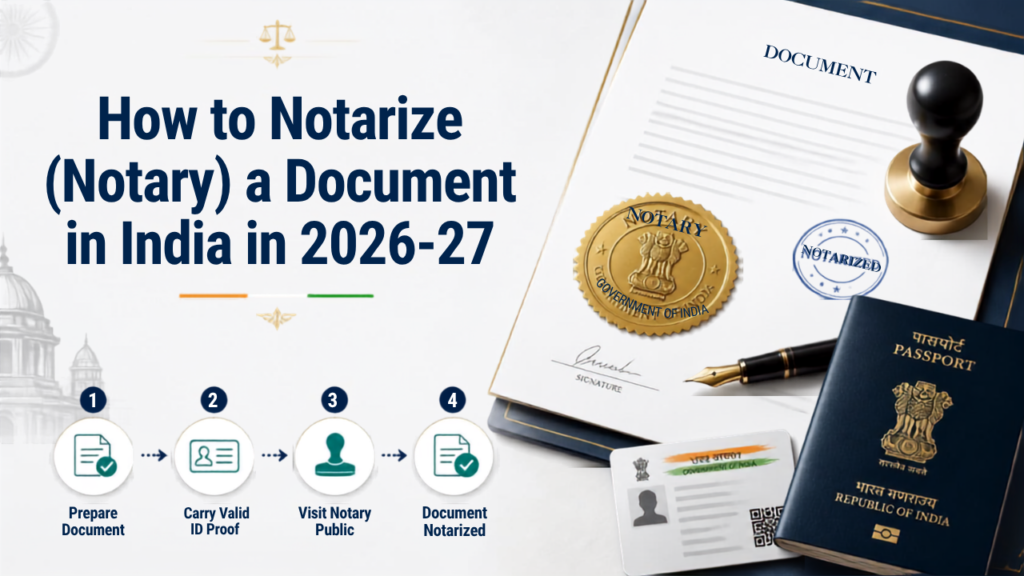
Notarisation is often the very first stamp a document receives on its way to being used abroad — yet many people are unsure who is actually allowed to do it. This 2026 guide explains who can legally notarise documents in India, what notarisation means, and where it sits in the wider attestation process.
Who is a notary in India?
A notary (notary public) is a person appointed by the Central or State Government under the Notaries Act, 1952. Notaries are typically experienced legal practitioners — advocates with several years of practice — who apply for and are granted a notarial appointment for a defined area of jurisdiction. Only a duly appointed and practising notary holding a valid certificate of practice can legally notarise documents.
What a notary is authorised to do
- Verify and authenticate signatures on documents.
- Attest and certify true copies of original documents.
- Administer oaths and take affidavits and declarations.
- Witness and record the execution of certain instruments.
What notarisation actually means
Notarisation confirms that a document was signed by the named person and, where relevant, that a copy is true to the original. It is a first-level authentication — it does not, by itself, make a document valid for use abroad. For international use, notarisation is usually just the starting point, followed by state-level verification, MEA attestation or apostille, and (for non-Hague countries) embassy attestation.
Where notarisation fits in the chain
For many personal and commercial documents — affidavits, powers of attorney, declarations, true copies — notarisation is the first step before the document moves to the Home Department, SDM or Chamber of Commerce, and then upward. Skipping or mishandling it can cause the whole chain to be rejected later.
A word of caution
Because notarial appointments are jurisdiction-specific and forgeries exist, ensure the notary is genuinely appointed and practising, with a valid seal and register entry. A properly notarised document carries the notary’s stamp, signature and notarial register number.
In short, only a government-appointed notary under the Notaries Act, 1952, can legally notarise documents in India — and while notarisation is an important first step, it is only the beginning of making a document ready for international use.
Quick FAQ
Can any lawyer notarise documents in India?
No — only an advocate who has been appointed as a notary under the Notaries Act, 1952, and holds a valid certificate of practice can notarise documents.
Does notarisation make a document valid abroad?
Not on its own. Notarisation is a first-level step, usually followed by state verification, MEA attestation or apostille, and embassy attestation for non-Hague countries.
How do I know a notarisation is genuine?
A valid notarisation carries the notary’s stamp, signature and notarial register number, from a notary appointed for that jurisdiction.
How Manav Corporate Consultants can help
At Manav Corporate Consultants (MCC), we manage the complete attestation and apostille journey end to end — state verification, MEA, embassy legalisation and destination-country formalities — with doorstep document pick-up and drop across India. As an ISO 9001:2015-certified, MEA-licensed firm, we keep the process fast, transparent and hassle-free.
Mumbai – +91 7738980318 / Chennai – +91 96770 59423 / Pune – +91 9970466594 | info@manavconsultants.com | www.manavconsultants.com