
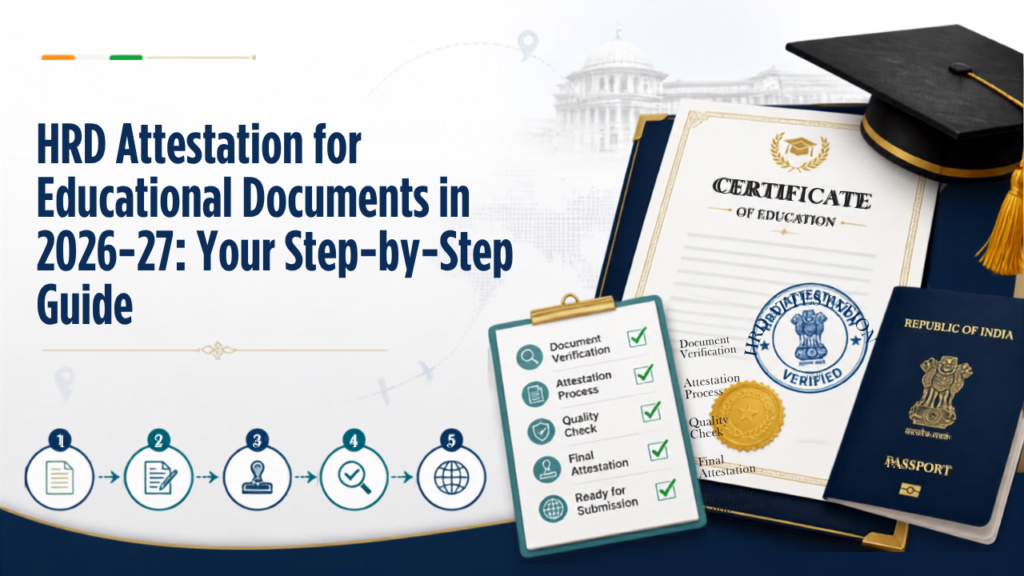
If you are taking an Indian degree abroad for work or study, HRD attestation is usually where the journey begins — and where most timelines are won or lost. This complete 2026 guide explains what HRD attestation is, why it is required, and how to get through it smoothly.
What is HRD attestation?
HRD attestation is verification of an educational document by the Human Resource Development (HRD) department of the state where the institution is located. The HRD confirms directly with the university or board that the certificate is genuine, then applies its seal. It is the state-level foundation on which MEA attestation or apostille is later built.
Why it is required
Higher authorities — the MEA and foreign embassies — cannot verify an Indian degree at source. They rely on the state’s confirmation. That is why, for most educational documents, HRD attestation must be completed before the MEA will apostille or attest the certificate, and before any embassy will legalise it.
Which documents need it
- Degree and postgraduate certificates.
- Diplomas and professional qualifications.
- Mark sheets and transcripts.
- School and higher-secondary certificates, where required.
The process in brief
- University genuineness verification, where the institution requires it.
- Submission to the relevant State HRD department.
- HRD verifies with the university and applies its attestation.
- The document then moves to the MEA for apostille or attestation.
Timelines — and why they vary
HRD attestation is often the slowest stage because it depends on the issuing university responding to the state’s verification request. Turnaround differs widely from state to state and university to university — from a week or two to over a month. Starting early is the single best way to protect your overall timeline.
The SDM alternative
Some applicants use a Sub-Divisional Magistrate (SDM) instead of HRD for speed. The MEA accepts SDM attestation, but the SDM does not verify with the university, and certain strict destinations or universities specifically require HRD. Use the SDM route only when you are confident your destination accepts it.
HRD attestation is the backbone of educational document legalisation. Confirm whether your university needs prior verification, approach the correct state HRD, and build in time — do that, and the rest of the chain falls into place.
Quick FAQ
Is HRD attestation compulsory for degrees?
For most educational documents, yes — the MEA and embassies rely on it, so it usually must be done before apostille or embassy attestation.
Can I use SDM attestation instead of HRD?
The MEA accepts SDM attestation, but some countries and universities insist on HRD. Use SDM only when your destination accepts it.
Why does HRD attestation take so long?
Because the HRD verifies the qualification directly with the issuing university, and response times vary by state and institution.
How Manav Corporate Consultants can help
At Manav Corporate Consultants (MCC), we manage the complete attestation and apostille journey end to end — state verification, MEA, embassy legalisation and destination-country formalities — with doorstep document pick-up and drop across India. As an ISO 9001:2015-certified, MEA-licensed firm, we keep the process fast, transparent and hassle-free.
Mumbai – +917738980318 / Chennai – +91 96770 59423 / Pune – +91 9970466594 | info@manavconsultants.com | www.manavconsultants.com