
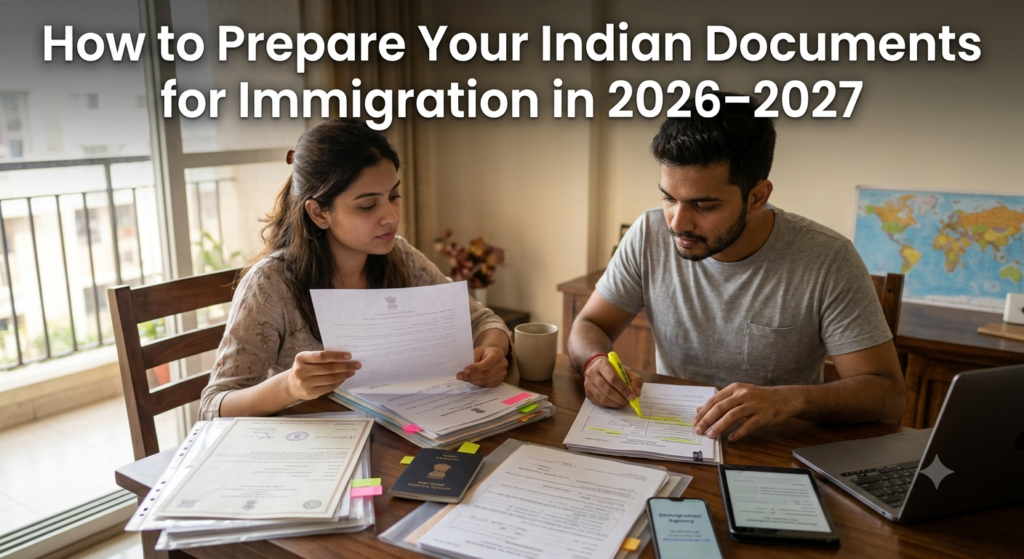
Immigrating abroad is a documents marathon, and the applicants who succeed smoothly are the ones who prepare their paperwork early and correctly. This 2026–2027 guide walks through exactly how to get your Indian documents immigration-ready — so legalisation never becomes the reason your application stalls.
Step 1 — Know which documents you need
Requirements vary by country and programme, but immigration applications commonly ask for educational documents (degrees, marksheets), a birth certificate, a marriage certificate, a Police Clearance Certificate, and experience certificates for skilled-migration routes. Start by getting your destination’s exact checklist.
Step 2 — Gather originals and fill the gaps
Locate originals or certified copies — photocopies cannot be apostilled. If a document is missing (a lost degree, or no formal birth certificate), begin the reissue or Non-Availability certificate process now, as these take time.
Step 3 — Check every detail against your passport
Names, dates and spellings must be consistent across all documents and your passport. Resolve mismatches early — by correction at source, or by bridging with an attested affidavit, marriage certificate or gazette notification.
Step 4 — Translate where required
If any document is in a regional language, arrange a proper translation — and confirm whether your destination needs it in English or in its own language (sometimes by a sworn translator).
Step 5 — Legalise via the correct route
Apostille for Hague Convention members; embassy attestation for non-members such as the UAE, Qatar and Kuwait. Some programmes also require credential assessment (for example, an educational evaluation) in addition to legalisation.
Step 6 — Mind the clock on time-sensitive documents
A PCC is usually accepted only if recent (often three to six months), so sequence it so it stays valid through your application. Start the whole process early, prepare documents as a consistent set, and keep certified copies and reference numbers.
Immigration success rests on documents the destination will accept. Confirm your checklist, gather and correct your documents, translate and legalise via the right route, and keep time-sensitive papers fresh — and your 2026–2027 application will move forward without paperwork surprises.
Quick FAQ
Which documents do I need for immigration?
Commonly educational documents, a birth certificate, a marriage certificate, a PCC, and experience certificates — exact requirements vary by country and programme.
Apostille or embassy attestation?
Apostille for Hague members; embassy attestation for non-members such as the UAE, Qatar and Kuwait. Some programmes also need credential assessment.
When should I start?
Early — legalisation takes weeks, and time-sensitive documents like PCCs must stay valid through the application.
How Manav Corporate Consultants can help
At Manav Corporate Consultants (MCC), we handle the complete apostille and attestation journey — checking your documents for issues before submission, then managing notarisation, state and Chamber of Commerce verification, MEA apostille and embassy legalisation — with doorstep pick-up and drop across India, transparent pricing and genuine, online-verifiable results. As an ISO 9001:2015-certified, MEA-licensed firm, we help you get it right the first time, without the errors, hidden costs or delays that catch applicants out.
Mumbai – +91 7738980318 / Chennai – +91 96770 59423 / Pune – +91 9970466594 | info@manavconsultants.com | www.manavconsultants.com