
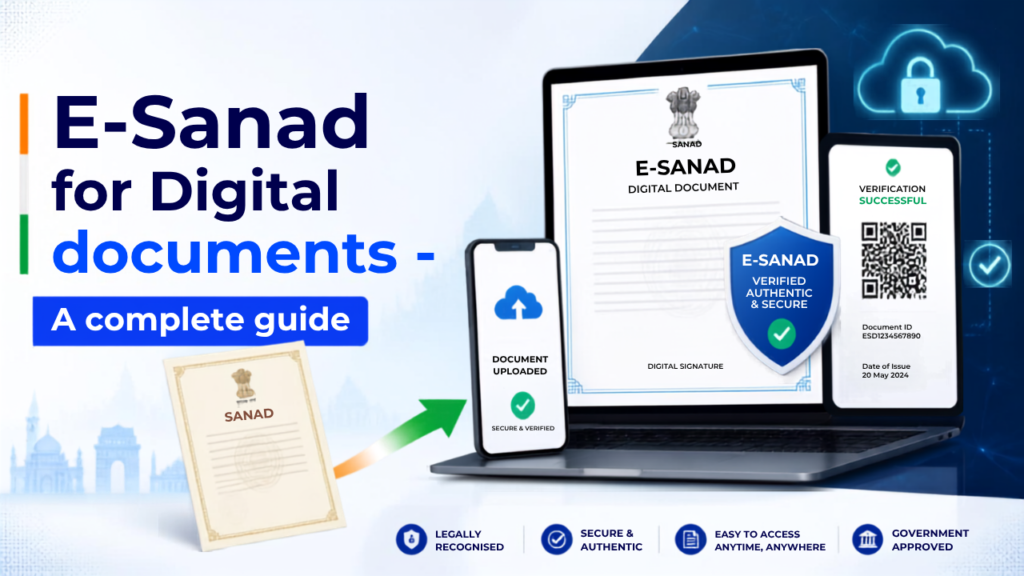
As more Indian certificates are issued and stored digitally, the way they are apostilled is changing too. In 2026, eligible digital documents can be verified and apostilled through the government’s e-Sanad platform — often without couriering originals anywhere. Here is how it works and where its limits lie.
What is e-Sanad?
e-Sanad (esanad.nic.in) is an online platform developed by the National Informatics Centre and operated by the Ministry of External Affairs. It aims to make document verification, attestation and apostille contactless, faceless, cashless and paperless. The system connects directly with document-issuing authorities to verify credentials electronically before the MEA applies its apostille.
The catch: your document must be in a digital depository
The essential requirement is that your document already exists in a linked digital depository. e-Sanad began with CBSE records (from 2014 onwards) and has expanded to the National Academic Depository and other authorities in phases, with more being integrated over time. If your issuing authority is integrated, the digital route is open to you; if not, you still use the traditional physical process.
Step-by-step for eligible documents
- Register on the e-Sanad portal and create your application.
- Select the issuing authority and the document held in the digital depository.
- The issuing authority verifies the document electronically.
- Pay the applicable fee online.
- The MEA processes the apostille — typically within about a week of successful verification, with total time (including depository verification) often around 15–20 working days.
- You receive the apostilled document, and its unique number can be checked on the e-Sanad portal.
If your document is not yet integrated
Many university and hospital records are still not in a digital depository. In that case, an apostille is still required — you simply take the traditional route: state-level attestation (HRD, Home Department/SDM, or Chamber of Commerce), then MEA apostille on the physical original. Both a digital and a physical apostille carry the same legal weight internationally.
One thing digital apostille does not remove
An apostille — digital or physical — only covers Hague Convention countries. For non-members such as the UAE, Qatar and Kuwait, embassy attestation is still required on top. Confirm your destination’s status before assuming the digital route completes your legalisation.
For documents already sitting in a linked depository, digital apostille is a genuine leap forward in speed and convenience. For everything else, the trusted physical route remains — and both end in the same internationally recognised result.
Quick FAQ
Can I get an apostille fully online in India?
For documents held in a linked digital depository (such as CBSE or NAD-integrated records), e-Sanad enables online verification and apostille. Documents not yet integrated still use the physical route.
How long does digital apostille take?
Often around 15–20 working days in total, with the MEA typically issuing the apostille within about a week of successful verification.
Is a digital apostille as valid as a physical one?
Yes. Both are issued by the MEA, carry a unique verifiable number, and have the same legal standing internationally.
How Manav Corporate Consultants can help
At Manav Corporate Consultants (MCC), we manage the complete attestation and apostille journey end to end — state verification, MEA, embassy legalisation and destination-country formalities — with doorstep document pick-up and drop across India. As an ISO 9001:2015-certified, MEA-licensed firm, we keep the process fast, transparent and hassle-free.
Mumbai – +917738980318 / Chennai – +91 96770 59423 / Pune – 9970466594 | info@manavconsultants.com | www.manavconsultants.com